
Note
Go to the end to download the full example code.
Plotting the Solar Orbiter Trajectory#
This example demonstrates how to to retrieve Solar Orbiter’s position using SunPy and JPL HORIZONS, through sunpy.coordinates.get_horizons_coord().
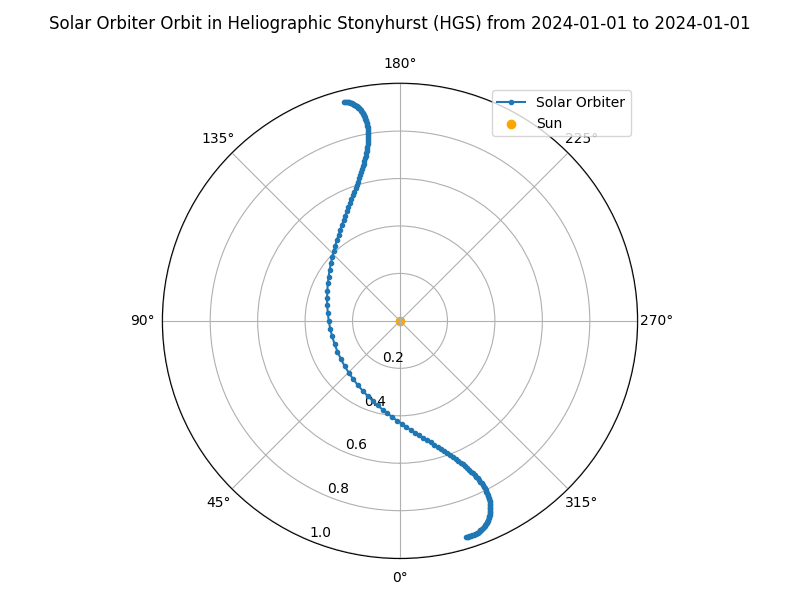
We will get the position of Solar Orbiter as a function of time and plot this in a polar plot of lon and radius in heliographic stonyhurst frame.
import matplotlib.pyplot as plt
from astropy.time import Time
import astropy.units as u
from sunpy.coordinates import get_horizons_coord
Get Solar Orbiter’s Ephemeris#
We use SunPy’s sunpy.coordinates.get_horizons_coord() to query Solar Orbiter’s position
from JPL HORIZONS. This returns coordinates in a SkyCoord object, in the Heliographic Stonyhurst frame.
times = Time("2024-01-01") + (u.Quantity(range(0, 180, 1)) * u.day)
solo_coords = get_horizons_coord("Solar Orbiter", times)
INFO: Obtained JPL HORIZONS location for Solar Orbiter (spacecraft) (-144) [sunpy.coordinates.ephemeris]
Plotting in the Heliographic Stonyhurst (HGS) Frame#
We plot Solar Orbiter’s radial distance from the Sun against its heliographic longitude using a polar plot. This gives a clear view of the spacecraft’s orbit around the Sun.
fig = plt.figure(figsize=(8, 6))
ax = fig.add_subplot(projection="polar")

ax.plot(solo_coords.lon.to(u.rad),
        solo_coords.radius.to(u.AU),
        label='Solar Orbiter', marker='.', ls='-')

# Mark the Sun at the origin
ax.scatter(0, 0, marker='o', color='orange', label="Sun")

ax.set_theta_zero_location('S')
ax.set_theta_direction(-1)
ax.set_title('Solar Orbiter Orbit in Heliographic Stonyhurst (HGS) from {:s} to {:s}'.format(times[0].strftime("%Y-%m-%d"),times[0].strftime("%Y-%m-%d")),
             pad=20)
ax.legend()

plt.tight_layout()
plt.show()
Total running time of the script: (0 minutes 0.811 seconds)